
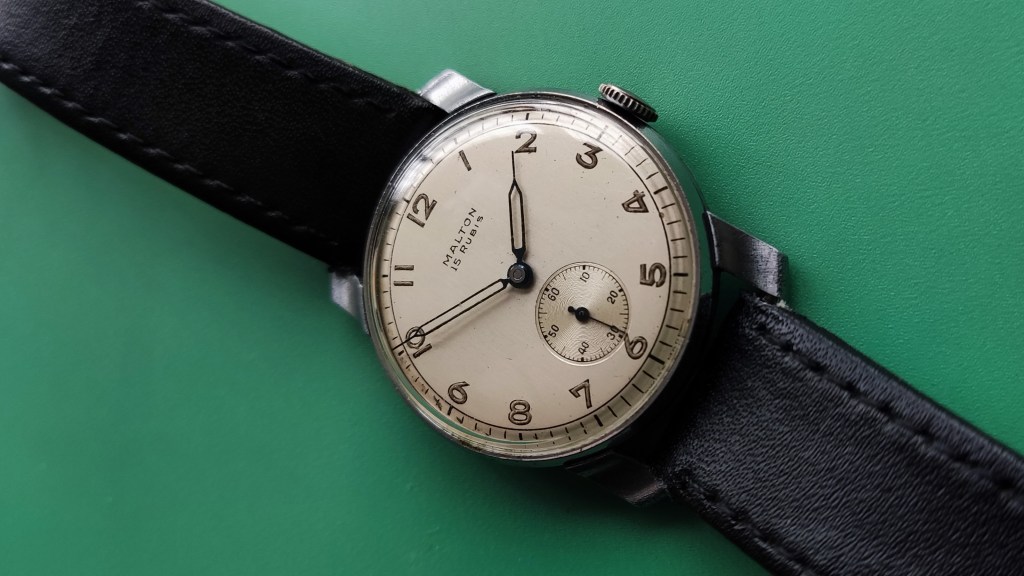
The watch was presented in working condition but was very dirty and running fast (minutes per day). It has a 1940’s A. Schild (AS) 984 movement. It has a utilitarian dial with a sub seconds dial. The hands had lume applied but this was chipped off in places. The case is an attractive, almost gunmetal finish with interesting lugs. There is a stainless steel case back and polished steel front bezel holding an acrylic crystal. I would say it has a military style to it. I would guess it’s American in origin, perhaps brought over to the UK during the Second World War.
Since the watch was working, it was a case of disassembling this timepiece, cleaning and regulating once reassembled.
The dial and movement are removed through the front of the watch once the bezel and rear case screws are removed. Once the hands were taken off, the dial is removed by dial foot screws on the top (gear train side) of the movement similar to an older pocket watch rather than the side of the main plate.
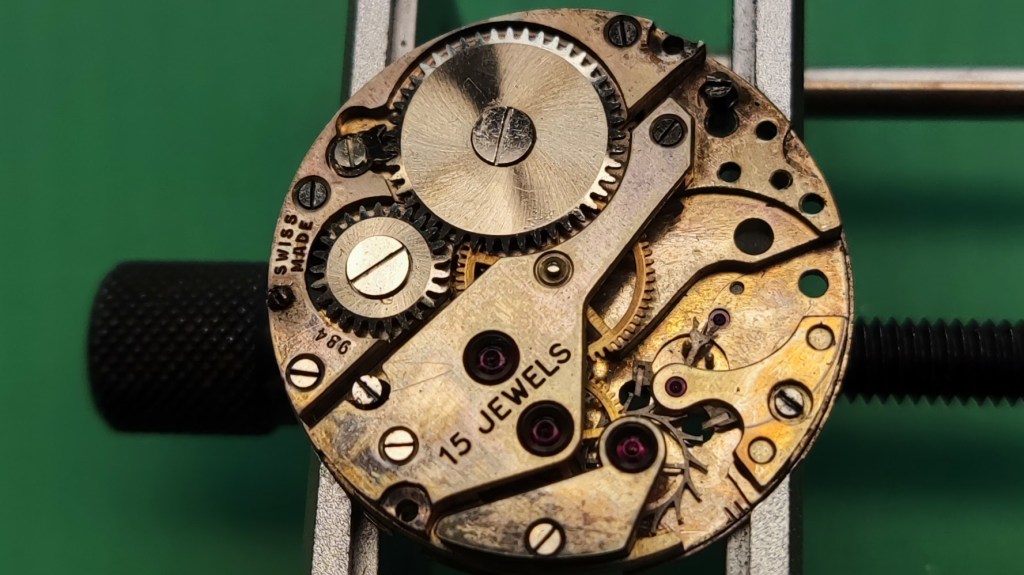
This is a traditional manual wind wristwatch with no complications, so has a straightforward layout. There is no incabloc and the balance wheel has balance screws. The only issue with disassembly was a stuck ratchet wheel screw. An anomaly with the AS 984 (and other AS movements) is that both the crown wheel AND ratchet wheel are reverse threaded. It is possible that this was previously overtightened in an attempt to loosen the ratchet wheel screw. In any case, the screw head eventually broke from the threaded screw shaft. This meant that the remaining threaded shaft within the barrel arbour could be removed with pliers.
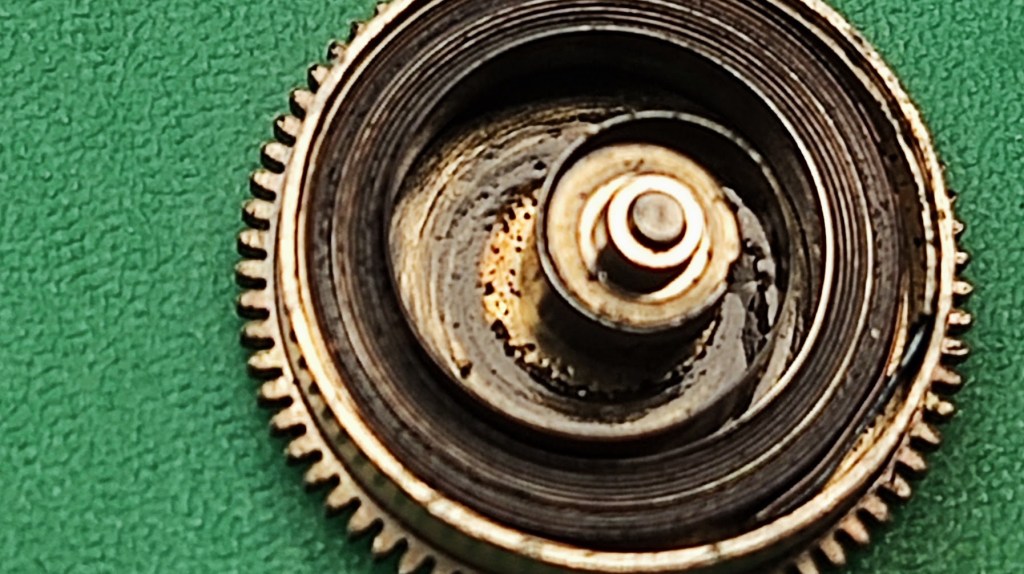
The mainspring was removed from the barrel and cleaned as this was one area where there was a large build up of old grease – it was filthy with far too much grease! The gear train and keyless works were removed with no issues.
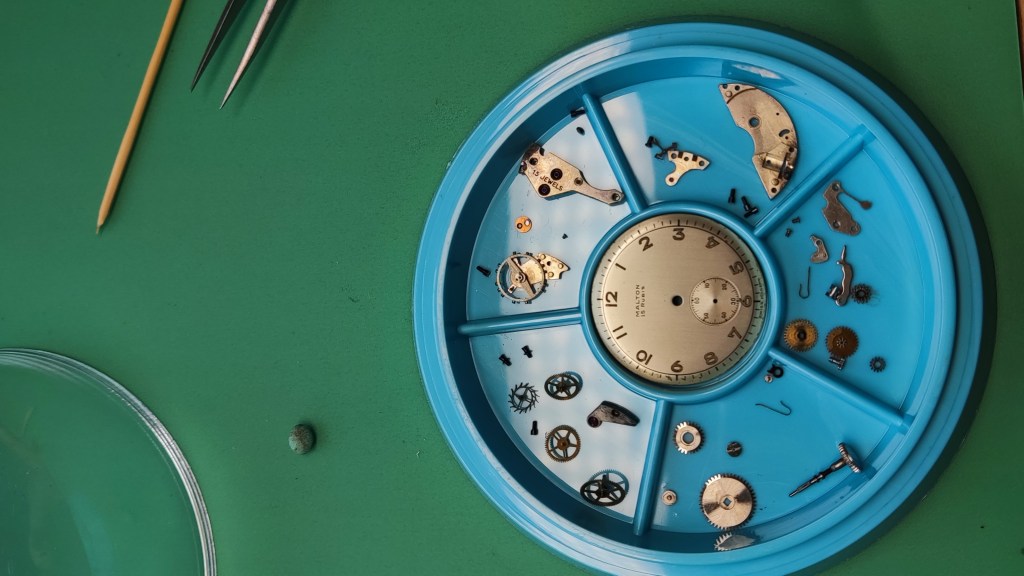
A replacement ratchet wheel screw was sourced and added to the parts for cleaning. These were all cleaned in the ultrasonic cleaner. I also removed the old lume from the hands as I like the old-fashioned look of “hollow” hands – certainly better than chipped, half lumed hands.
Assembly was relatively straightforward and I concentrated on correct lubrication so for the mainspring and barrel I used moebius 8200 as well as for the stem. For high friction areas of the keyless works and on the cannon pinion/centre wheel I used Moebius 9104 (HP 1300). And for the jewels / pivots I used Moebius 9010.

The balance was added and ticking commenced – a great sight! The watch was running very fast at some 300+ seconds per day and with a beat error of around 4. This was reduced to 0 or +1 seconds with a beat error of 0.2. Having tested the watch for 48 hours it has yet to lose a second – which for an 80 year old timepiece is a great outcome.
This Malton watch is now for sale at £132 – please contact us for details.
 Fitzgerald Watch Company Ltd - Watch Repair
Leave a comment